The mini framework smell test: how abstraction layers quietly kill teams
December 19, 2025
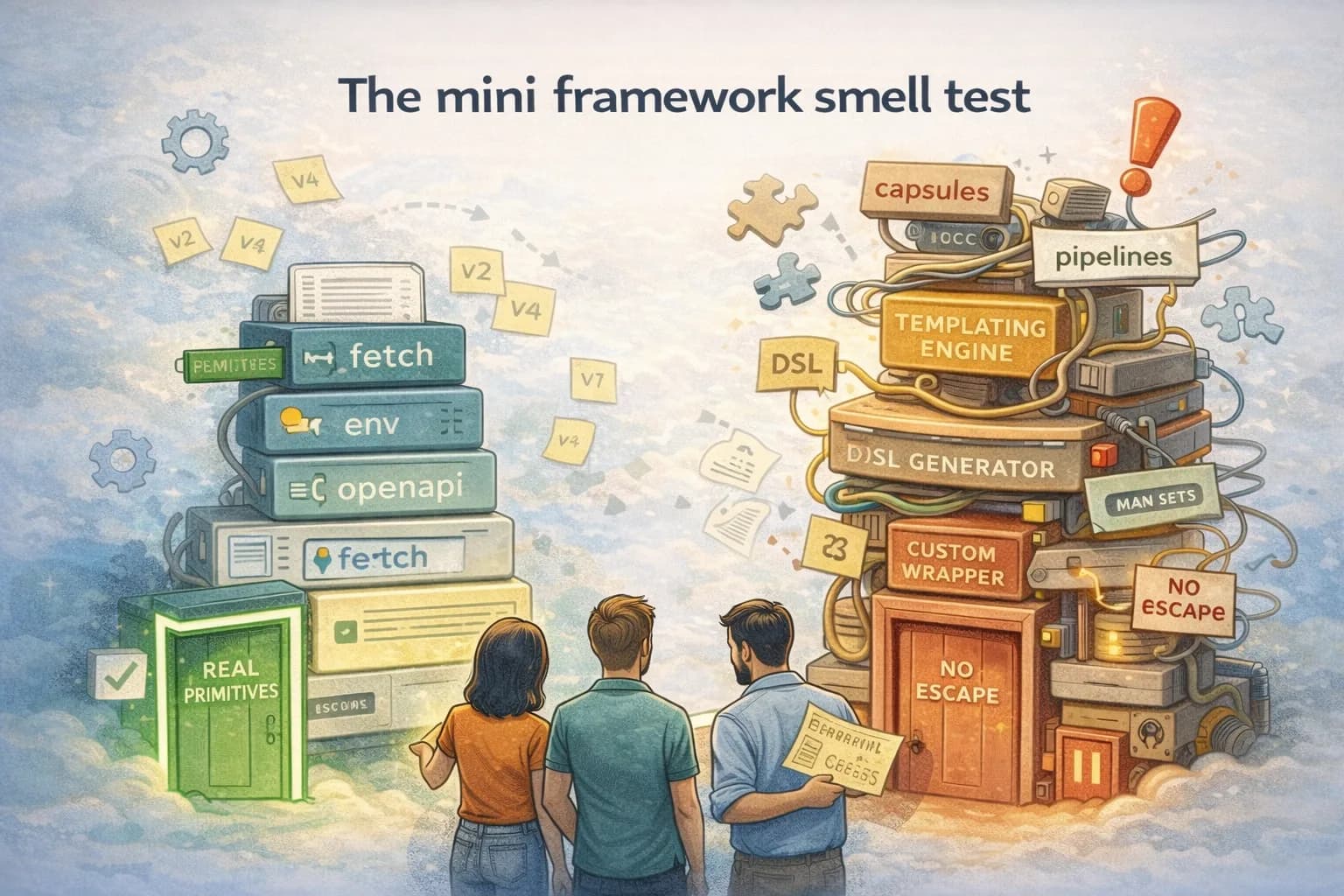
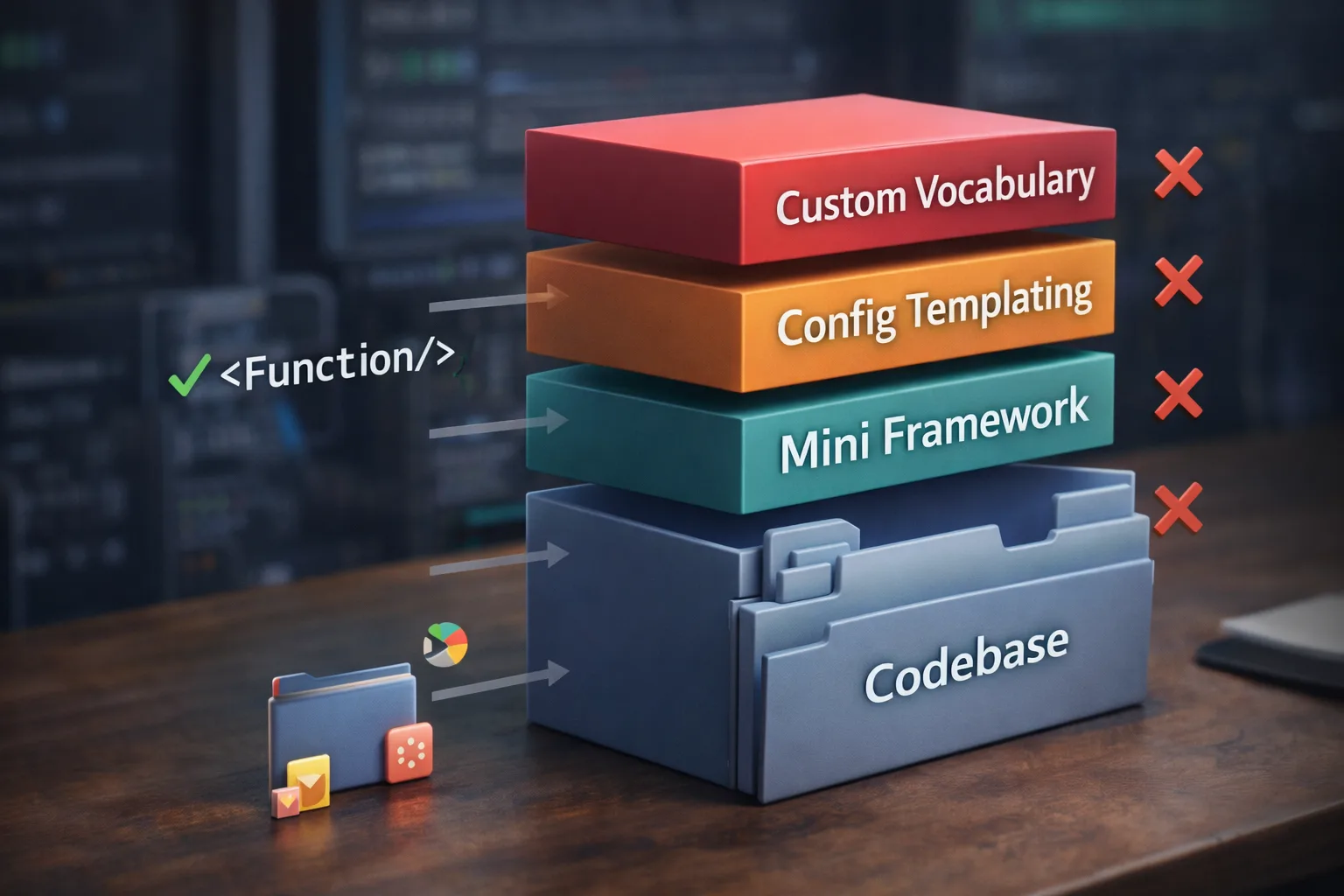
If you have shipped more than one serious web app, you have probably felt it: a “mini framework” emerges inside the repo. It starts as a helper function, then a wrapper, then a convention, then a vocabulary, then a team rule. After a few months the codebase has two frameworks: the real one (Next.js, React, Node, whatever) and the homegrown one that sits on top.
At first it looks like velocity. Later it looks like confusion.
This post is a smell test, not a moral lecture. Abstraction is not bad. Teams need abstractions. The problem is the kind that quietly increases cognitive load, removes escape hatches, and turns debugging into archaeology.
If your visitors are the type to question everything, this is the version of the article I would want in front of them: concrete examples, clear tradeoffs, and a decision tree you can use in a meeting.
What I mean by “mini framework”
A mini framework is an internal layer that:
- Redefines how you do ordinary things (routing, config, data fetching, logging, feature flags).
- Adds a required pattern on top of an existing ecosystem.
- Forces new vocabulary that is not widely searchable.
- Makes the simple path less direct, while promising long-term consistency.
Sometimes it is justified. Sometimes it is a coping mechanism for problems that should have been solved with off-the-shelf tooling.
Smell test #1: Config templating as a product
The pattern
Someone creates a “config factory” because multiple services need the same settings. That is a valid goal. Then it grows.
You start with:
config.tsthat merges env vars and defaults.
Then it becomes:
- A templating layer that generates config files.
- A build step that renders templates.
- A DSL for conditional configuration.
Suddenly, changing a timeout involves editing a template, re-running a generator, and remembering which layer wins.
Why it hurts
- Debugging becomes multi-stage: “Is this value from env, from template default, from render-time override, or from runtime?”
- You lose observability: production config is not what your source config says.
- You reduce portability: the project now requires the template engine and its rules.
Least-bad alternative
- Use plain env vars with one typed loader.
- Keep config resolution in one place.
- Print effective config at startup (redacting secrets).
If you want a standard, start with the boring one: the Twelve-Factor App config principle.
Smell test #2: Wrappers around stable primitives
The pattern
You wrap fetch() because you want consistent headers and retries. Reasonable.
Then the wrapper becomes:
- A new API that hides status codes.
- An auto-retry that retries POST by accident.
- A “request context” object that gets threaded everywhere.
And soon the team no longer knows what the underlying primitive does.
Why it hurts
Wrappers are expensive when they remove the ability to reason about the base behavior. That makes bugs look random.
The most common wrapper problems I see:
- Error normalization that erases the useful part of the error.
- Retries that are not idempotent.
- Logging that consumes response bodies.
- Timeouts that are not enforced consistently.
A good wrapper is thin, explicit, and optional.
Docs that matter for real behavior:
Smell test #3: Invented vocabulary
The pattern
A team coins new words for existing concepts:
- “Capsules” instead of components.
- “Pipelines” instead of middleware.
- “Manifests” that are actually config.
- “Artifacts” that are actually build outputs.
Why it hurts
Invented vocabulary reduces searchability.
When you hit a bug in Next.js routing, you can search “Next.js dynamic route not found.” If your team calls it a “PortalMap,” your juniors cannot search anything. Your seniors end up as translators.
It also increases onboarding time. Every new hire pays a tax that your product does not pay you back for.
Least-bad alternative
- Use ecosystem words unless you are naming a genuinely new concept.
- If you must invent a term, write down the mapping in a glossary and keep it short.
Smell test #4: Golden paths with no escape hatches
A “golden path” is healthy until it blocks progress.
Examples:
- You cannot add a new endpoint without using the internal routing generator.
- You cannot ship a page without a custom layout wrapper.
- You cannot run a one-off script without importing the platform runtime.
When escape hatches disappear, engineers stop experimenting. That is usually the moment a team’s output starts to flatten.
A serious team rule: every abstraction must have a documented escape hatch.
Smell test #5: Tooling that produces more tooling
If your internal framework requires:
- its own CLI
- its own code generator
- its own docs site
- its own versioning
You are not building a helper. You are building a product. That is a different commitment.
If you are not staffed to maintain a product, you should not create one accidentally.
A good baseline for “product-level commitment” is whether you can write:
- a changelog
- a migration guide
- versioning rules
If you cannot, you are not ready.
For version discipline, Semantic Versioning is still the least confusing language across teams.
Smell test #6: The abstraction moves faster than the business
This is the quiet killer.
If your abstraction layer changes every sprint, it is not stabilizing the codebase. It is turning the codebase into moving sand. Teams spend time updating patterns instead of shipping product value.
Indicators:
- Internal framework “v2” arrives before the business feature ships.
- PRs touch many files because “this is the new pattern.”
- Reviews focus on conformance rather than correctness.
What to do instead (practical moves)
Here are improvements that increase consistency without creating a shadow framework:
- Write tiny, local utilities
- Prefer pure functions with narrow scope.
- Keep them easy to delete.
- Standardize interfaces, not implementations
- Example: require services to expose an OpenAPI spec, not a shared server runtime.
- OpenAPI gives you shared language without shared lock-in.
- Document a “how we do X” page
- Keep it to one screen.
- Include examples and counterexamples.
- Invest in linters and templates
- Linting is constraint without runtime coupling.
- A repo template is a suggestion you can override.
- Use a tool your future hires already know
- If a practice is searchable, it is cheaper.
The review questions I ask before approving a new abstraction
If you want a practical way to apply this smell test, use it in code review. When someone proposes a wrapper, a platform package, or a “standard way,” ask a small set of questions that force clarity.
- What is the concrete problem it solves?
- “We have incidents because request timeouts are inconsistent” is concrete.
- “We need consistency” is not.
- What happens when it fails?
If the abstraction breaks, do we get:
- a clear error message?
- a safe fallback?
- an obvious escape hatch?
If the answer is “it depends,” you are building a risk multiplier.
- Can I bypass it during an incident without rewriting everything?
If an on-call engineer cannot bypass the abstraction at 3am, it is too sticky.
- Does it reduce or increase the number of concepts a new hire must learn?
If you invented a new term for something the ecosystem already names, you are charging onboarding rent.
- Is it thinner than the primitive it wraps?
Healthy abstractions are thin.
- They expose status codes instead of hiding them.
- They do not swallow errors.
- They make retries explicit.
If the wrapper is thicker than the primitive, you are no longer abstracting complexity; you are relocating it.
A useful rule
If the “standard way” prevents you from doing the unusual-but-necessary thing, it is not a standard — it is a trap.
Document the escape hatch (a one-page pattern)
If you do build an internal abstraction, the easiest way to reduce long‑term damage is to document the escape hatch in plain language.
Keep the doc short and practical:
- What it is: one sentence.
- When to use it: 3–5 bullets.
- When not to use it: 3–5 bullets.
- How to bypass it: one example with the raw primitive.
- How to debug it: what logs/flags exist.
This forces the team to acknowledge the failure modes up front. It also gives new hires a map: “this is optional, this is how it fails, this is how to work around it.”
The decision tree: build vs adopt
Use this like a checklist. If you answer “no” too often, adopt.
Step 1: Is the problem real and repeated?
- Have at least 3 different teams hit the same problem in the last quarter?
- Is the cost measurable (incidents, on-call load, missed delivery dates)?
If not, do not build. Write a short guideline and move on.
Step 2: Is there a mature, maintained solution?
- Is there an established library with active maintenance?
- Does it match your constraints (security, enterprise network, compliance)?
If yes, adopt, and wrap minimally.
Step 3: Do you need unique behavior that others do not?
Examples that justify building:
- You operate on locked down networks where standard transports fail.
- You need a strict data model and audit trails.
- You have unusual scale or latency constraints.
If your needs are not unique, you are probably customizing preferences, not solving a new problem.
Step 4: Can you commit to maintenance?
Answer “yes” only if you can commit:
- an owner
- a roadmap
- versioning rules
- migration support
- on-call responsibility if it breaks
If not, do not build.
Step 5: Can engineers bypass it when needed?
If a developer cannot escape the abstraction during an incident, your framework is now a risk multiplier.
Require an escape hatch.
How this connects to ClipNotebook
ClipNotebook started by solving one job: save, organize, and share link collections cleanly. When you do that, “mini frameworks” show up too: custom metadata pipelines, wrappers around storage, wrapper APIs for sharing.
The way we keep it sane is simple: use the platform primitives directly where possible, keep helpers thin, and keep the vocabulary searchable.
That same approach applies to your team.
Final thought
A mini framework rarely fails loudly. It fails quietly: onboarding slows, bugs take longer, and engineers spend more time learning internal patterns than solving user problems.
Use the smell test. Keep abstractions thin. If you build, build deliberately, with ownership and escape hatches. If you adopt, adopt confidently and focus your creativity on what your users actually pay for.