Tesla Flying Roadster: Does It Make Sense on Public Roads?
October 16, 2026
On October 15, 2026, Tesla’s new Roadster drove up an upside-down ramp, flipped in mid-air using cold-gas thrusters developed with SpaceX, landed on its wheels and hit 60 mph in a claimed 0.81 seconds (Electrek). TechCrunch and CNBC both covered the demo at a SpaceX test site in Texas.
It was a jaw-dropper. Then came the question I couldn’t shake: what happens when this leaves a closed test site and meets cyclists, potholes, traffic lights and other drivers?
This isn’t a “Tesla can’t build it” take. The engineering is real. The question is which of these features would actually make everyday driving better, and what’s still unproven.
Key takeaways
- Only one trim flies. The single-seat Rocket is invite-only and not approved for public roads.
- The Thrust trim’s gas lasts roughly 5–6 seconds. Refilling currently takes 2–6 hours. Tesla is aiming for under 30 minutes.
- Cold-gas thrust isn’t free. The gas has to be compressed somewhere, and Tesla hasn’t published the energy numbers.
- Rough roads, noise and landing space are open questions. Tesla’s own patent acknowledges the rough-road trade-off.
- Verdict: a remarkable engineering demo, not yet proven as an everyday feature.
Tesla Roadster trims: Performance vs. Thrust vs. Rocket
Not every Roadster is a flying car, and the practical questions differ by trim. Specs below are as Tesla presented them (Electrek, TechCrunch):
- Performance (2 seats): fan-based suction system and active aerodynamics. 0–60 mph in under 1.6 seconds. Tesla calls it “road ready.”
- Thrust (2 seats): adds four rear cold-gas thrusters and a 200-liter gas tank. Under 0.9 seconds, and 0.81 in the live demo. Tesla calls it “race ready.”
- Rocket (1 seat): 10 thrusters, 600 liters of gas in total and the full flight system. Under 0.59 seconds. Invite-only and not approved for public roads (Decrypt).
The gas-supply and refilling questions apply mainly to the Thrust. Takeoff and landing apply only to the Rocket. With that in mind, here are five reasons these features are harder to justify in everyday traffic than on a test track.
1. The rear thrust blast has to go somewhere
Picture yourself on a motorcycle at a red light, with a Roadster stopped right in front of you. The light turns green and the driver fires the rear thrusters.
Tesla engineering VP Lars Moravy says the thrusters produce more than 80 kilonewtons of thrust (summary of Hagerty’s interview). The physics is the same as any rocket: NASA’s thrust equation says thrust comes from how much gas you push backward and how fast it leaves. On a street, “backward” means cyclists, loose gravel, dust or the car behind you.
A caveat: 80 kN of thrust doesn’t mean a pedestrian would feel 80 kN. The effect depends on distance, direction and the real exhaust plume, and public reporting shows no bystander-exposure data yet. But exhaust momentum doesn’t vanish. On a closed track you can keep the zone behind the car empty. On a public road you can’t.
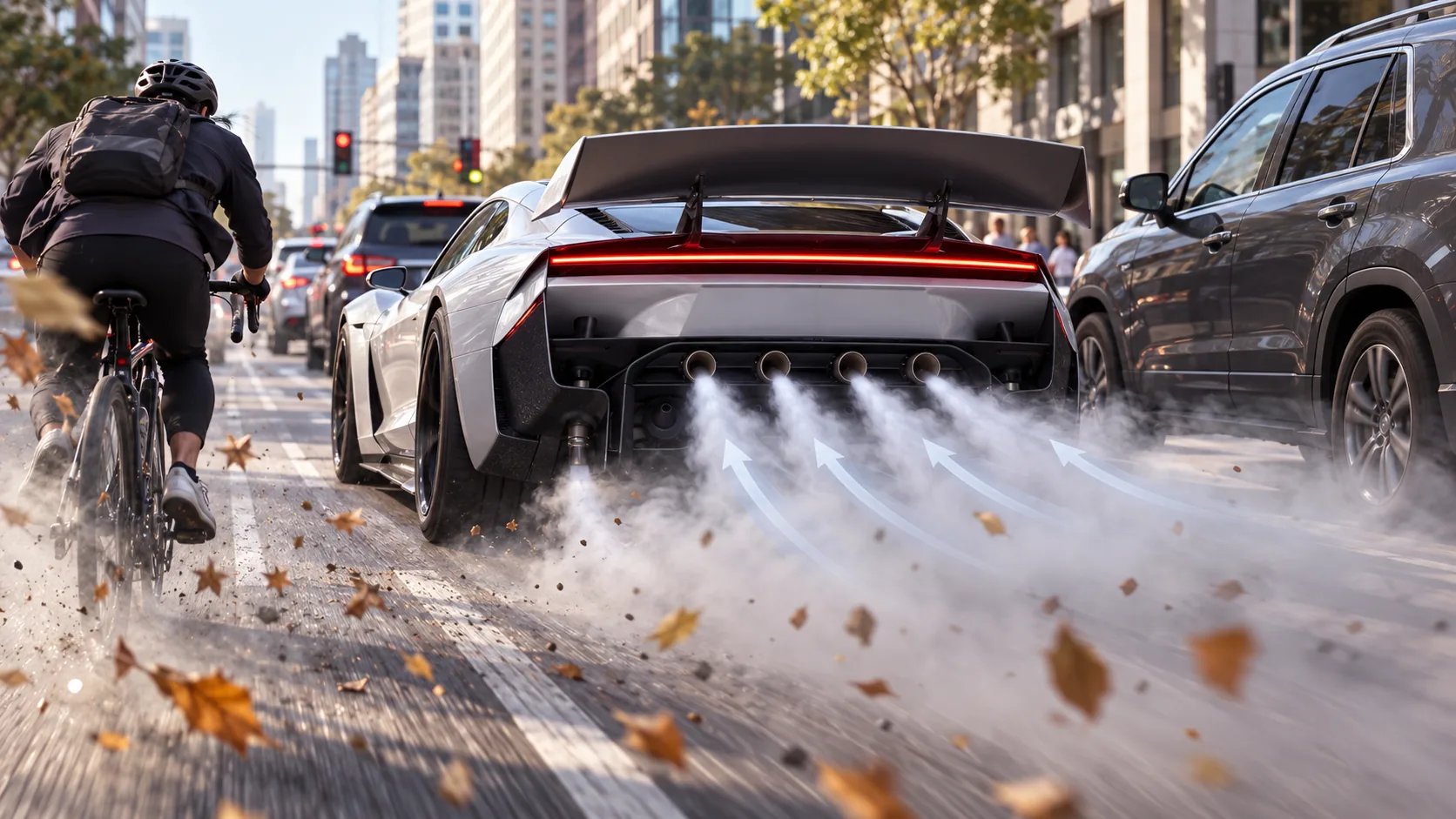
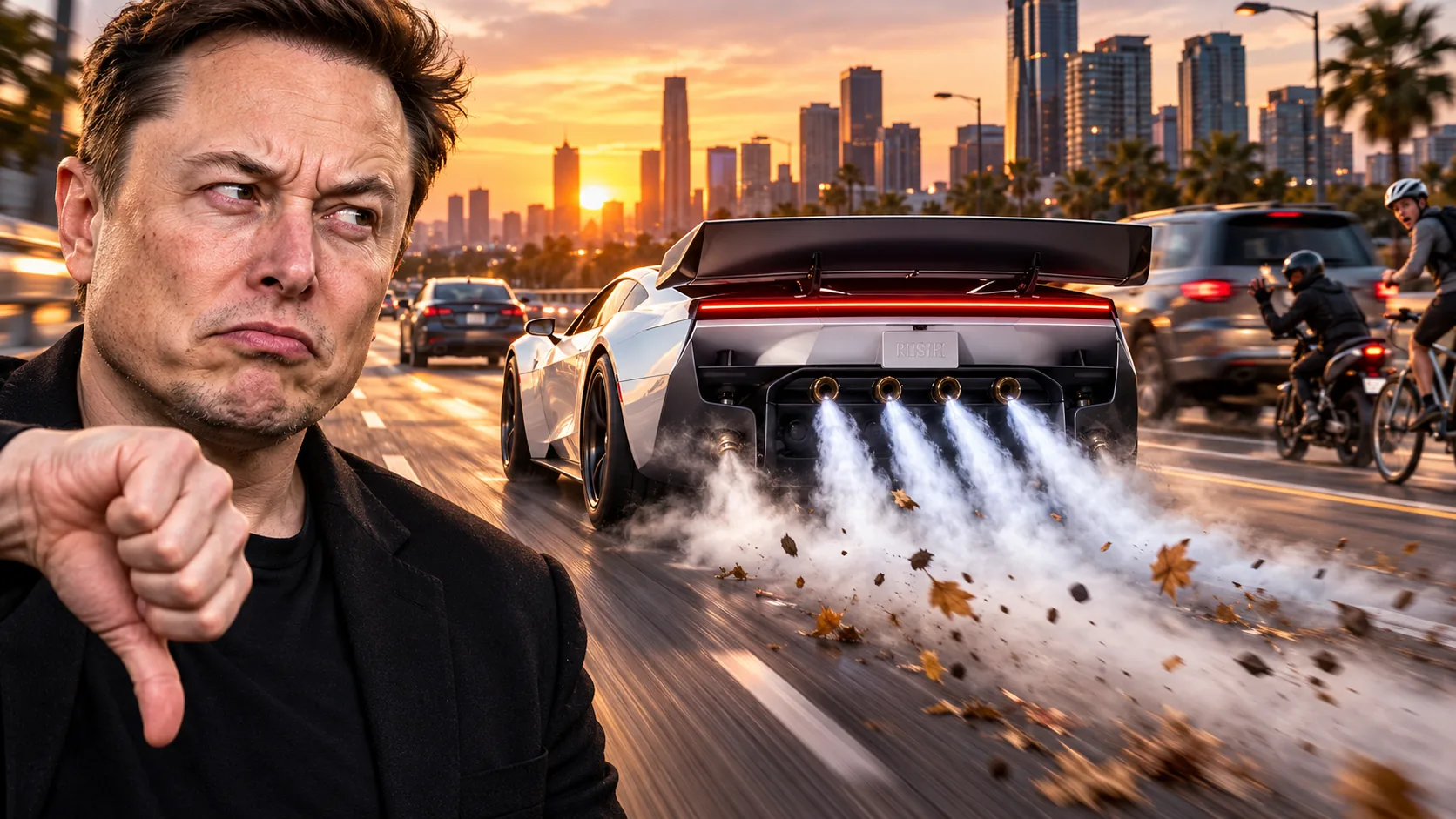
Concept illustration showing the direction of exhaust flow. Actual air velocities, debris movement, and safe distances have not been independently measured.
2. The thrust runs out in about six seconds
Electric motors handle everyday driving. The thrusters add a burst of extra push from stored gas, and that supply is small.
Top Gear reports that the Thrust trim’s 200-liter tank empties in about six seconds, and InsideEVs says five to six. That’s a reported discharge time, not a verified six seconds at maximum thrust. In practice, each fill is a one-shot deal.
Then there’s the refill. In a Top Gear walkaround, Moravy said filling the tank from an external high-pressure nitrogen supply currently takes two to six hours. Tesla’s goal is under 30 minutes. Musk has also talked about self-refilling tanks, but how that fits with the external-nitrogen process hasn’t been explained. Even the gas is a loose end: Tesla called it compressed air on stage, while engineers described nitrogen in interviews (EVXL).
So you buy a very expensive car for its rocket-assisted launches, take one full-power run, then wait hours for the gas to come back. These are prototype-stage figures and Tesla may improve them a lot. But today the Roadster’s signature performance depends on a small supply that is slow to replenish.
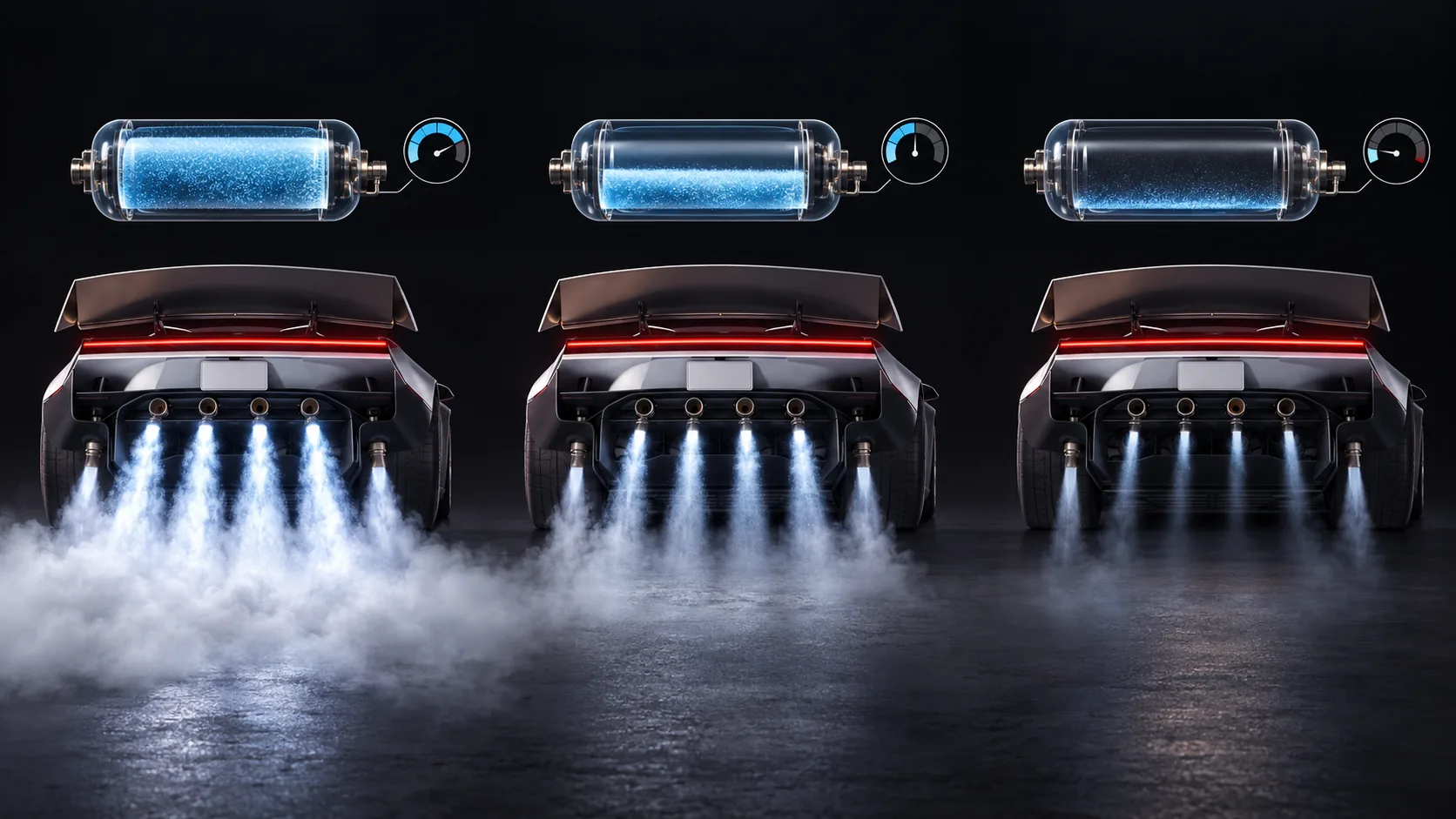
Illustration of a finite compressed-gas supply. The actual pressure and thrust decline depend on the system’s operating conditions.
3. Compressed gas isn’t free
Cold-gas thrust burns no fuel, which sounds clean and cheap. But think of a tire inflator: the air costs nothing, the compressor does.
Getting gas into a tank that reportedly holds up to 10,000 psi (Hagerty interview summary) takes energy, creates heat and needs equipment, whether that’s a high-pressure filler at a shop or a future system built into the car. The suction fans also draw electricity while they run.
None of this means normal driving gets expensive. But Tesla hasn’t published compressor power, refill energy or fan consumption so far, so anyone quoting an exact daily running cost is guessing. The useful question is: how much extra energy, hardware and waiting time is worth a few seconds of extreme acceleration? On a track day, plenty, maybe. On the supermarket run, much less obviously.
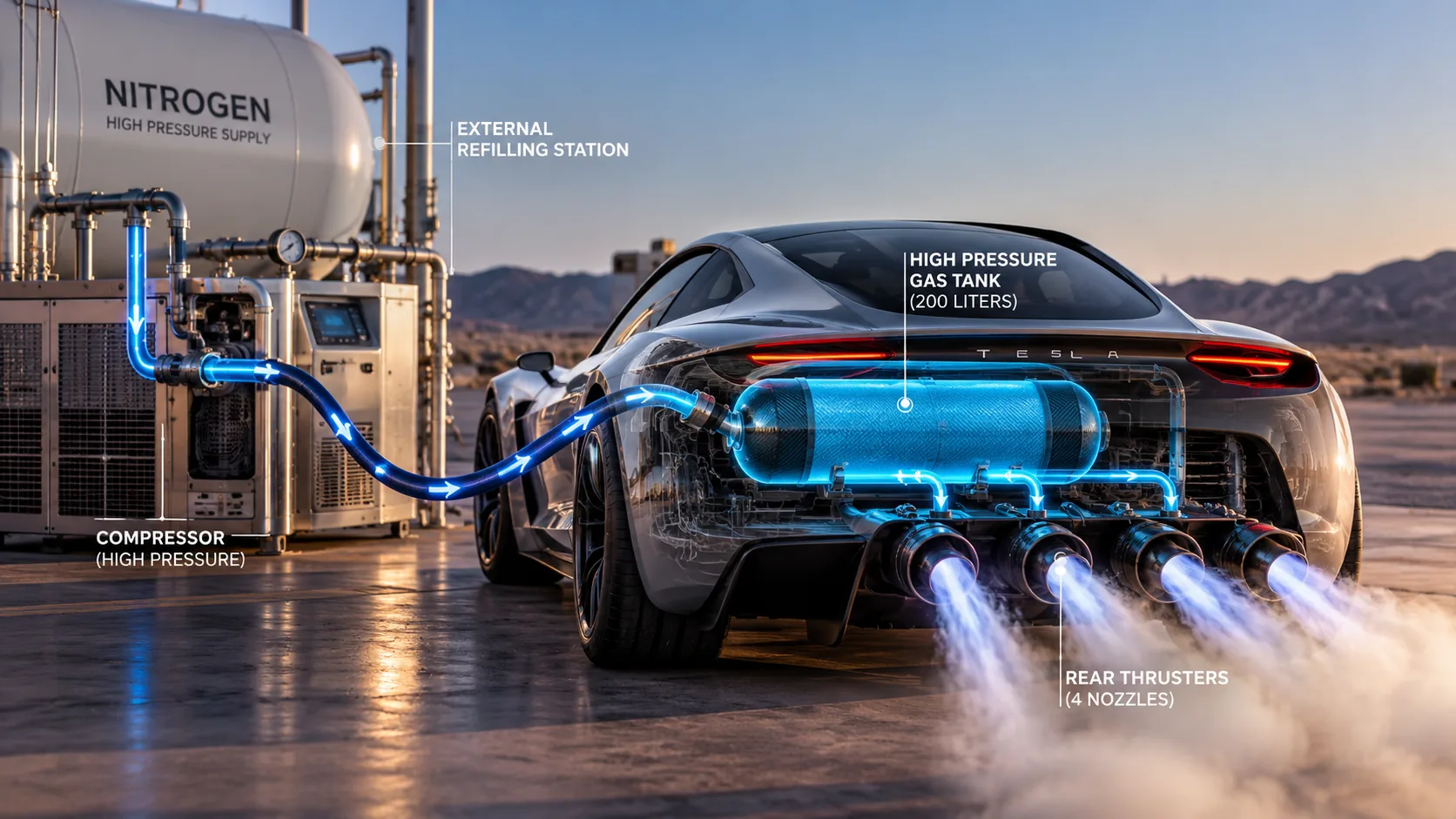
Simplified engineering explanation. The prototype’s exact gas-refilling equipment and energy consumption have not been published.
4. Suction fans vs. real roads (and the noise)
The suction system uses fans to pull air out from under the car, creating low pressure that presses it onto the surface, even at a standstill. That’s how the prototype clung to an inverted ramp.
Real roads have potholes, speed bumps, puddles, manhole covers and gravel, though. Tesla clearly knows: its patent for this kind of system, US 12,377,920, describes a fully sealed maximum-downforce mode for smooth surfaces and a second mode with fewer skirts down for uneven terrain. It even describes partly deploying the skirts on public roads to keep ground clearance, and mesh filters to stop rocks being sucked into the fans. That’s a genuine trade-off: more suction means less clearance and more wear risk.
Then there’s noise. OSHA’s technical manual calls compressed-air systems one of the most common noise sources in manufacturing, because high-velocity air creates turbulence as it mixes with the surrounding air, and notes that sound intensity scales with roughly the eighth power of air velocity. Add powerful fans and you have two loud systems. As far as public reporting shows, Tesla hasn’t released noise measurements for any mode, so claiming a specific decibel level or legal violation would be guesswork. Whether it’s acceptable near homes needs proof.
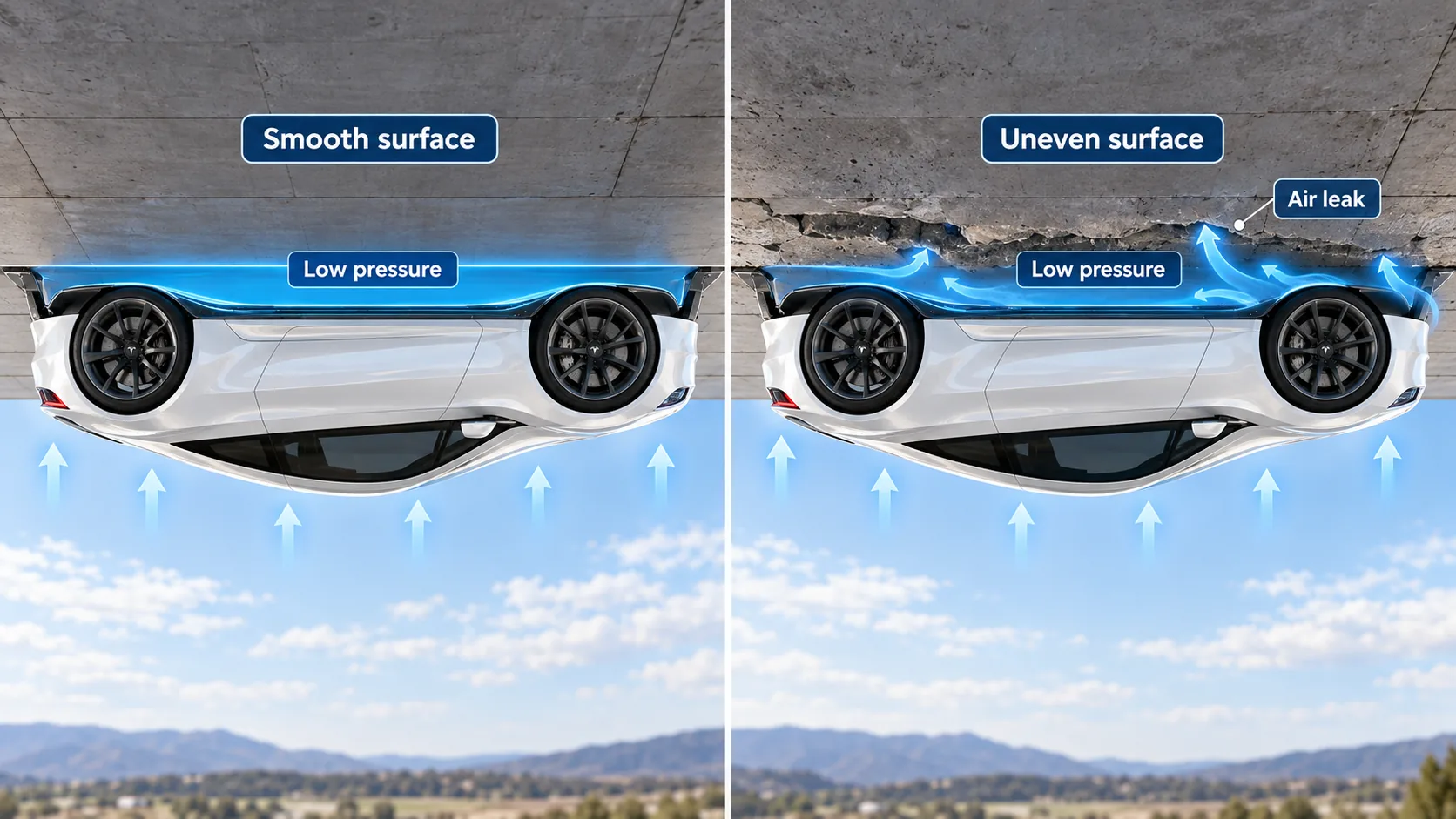
Conceptual comparison showing how road clearance and surface irregularities can affect an underbody suction system.
5. A jump isn’t the same as flight
Tesla showed short, controlled maneuvers: a launch off a ramp, a flip, a hop over a row of Tesla vehicles and a landing. It didn’t show a car flying from A to B over traffic. Electrek noted the crowd stood hundreds of meters away.
Now imagine being stuck in a traffic jam with a car that can jump. Where does it land? What if another car moves into the gap? How much gas is left for a controlled descent?
Flight also has a price. The Rocket carries 600 liters of gas, and its extra 400-liter tank takes the place of the passenger seat. Tesla isn’t promising owners will leap rush-hour traffic: the full flight system is experimental and invite-only.
Leaving the ground for a few seconds isn’t the same as having a useful way to travel.
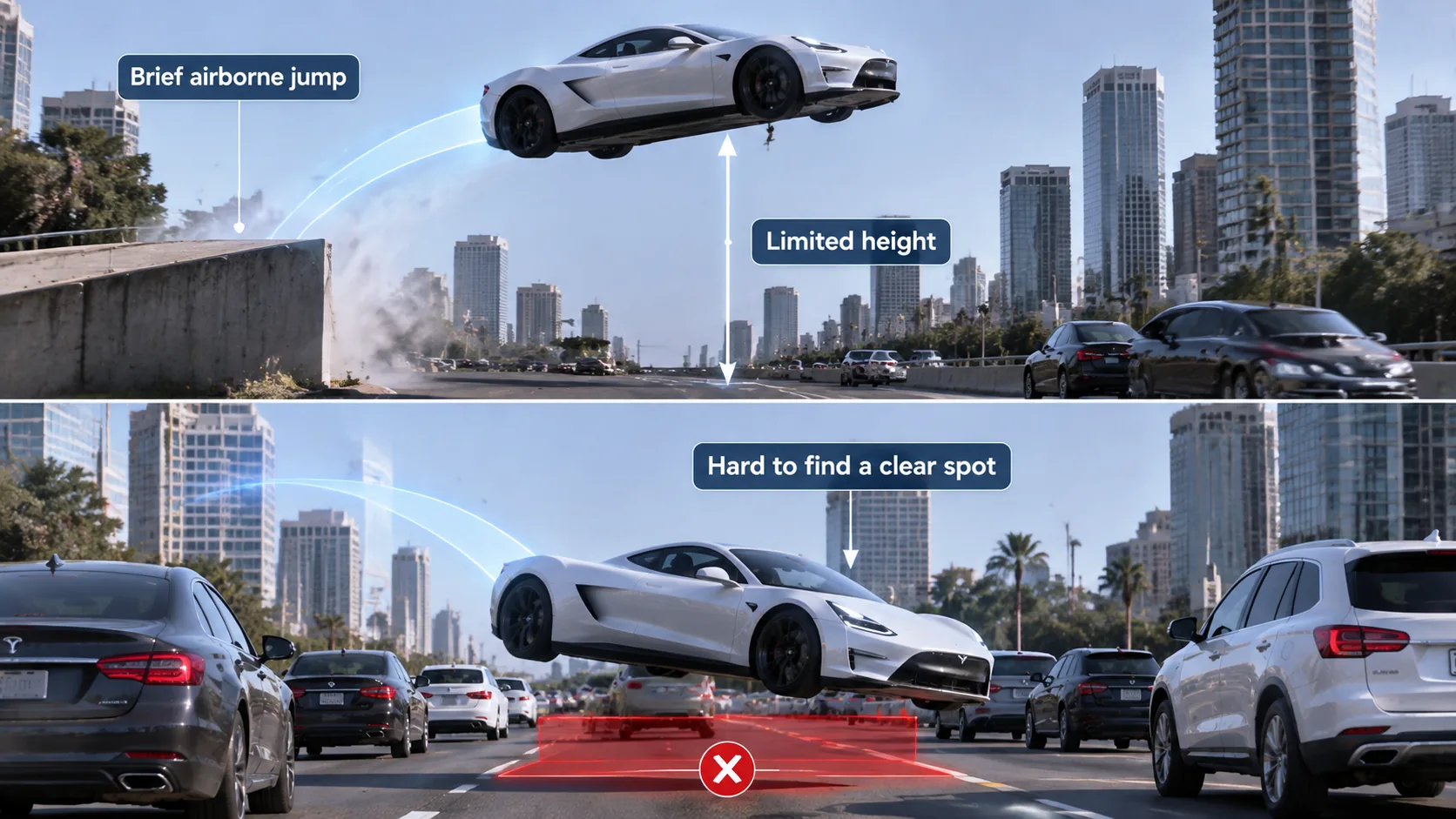
Hypothetical transportation scenario. This does not represent Tesla’s measured flight height, distance, or landing performance.
What would change the picture
Before calling these features practical for public roads, the most useful evidence would be:
- Independent measurements of exhaust effects near bystanders
- Repeat-launch performance, plus verified refill time and energy
- Noise measurements in every operating mode
- Rough-road reliability for the suction system
- A demonstrated safe landing in realistic conditions
Bottom line: is the flying Tesla Roadster pointless?
No. As an engineering demo and a rare performance car, it’s fascinating, and Tesla may solve several of these problems. The Performance trim doesn’t even have the gas-supply issues.
But the Roadster has proved something narrower than the hype. It can do extraordinary things in a controlled demonstration. It hasn’t yet proved those things make everyday driving better.
Tesla Roadster FAQ
Can the Tesla Roadster really fly?
Not in the sense of flying from A to B. At the reveal, the car used cold-gas thrusters to leave a ramp, flip, hop over a row of other Tesla vehicles and land. That’s a short, controlled hop. Only the single-seat Rocket trim has the full flight system.
How fast is the Tesla Roadster from 0 to 60 mph?
Tesla claims under 1.6 seconds for the Performance, under 0.9 for the Thrust and under 0.59 for the Rocket. The live demo showed 0.81 seconds after some timer problems (Electrek). These are Tesla’s own numbers.
How long do the Roadster’s thrusters last?
On the Thrust trim, the 200-liter gas tank empties in roughly five to six seconds. Refilling from an external nitrogen supply currently takes two to six hours, and Tesla is aiming for under 30 minutes.
Is the Tesla Roadster street legal?
Tesla calls the Performance trim “road ready” and the Thrust “race ready” (Electrek). The Rocket is invite-only and not approved for public roads.
When can you buy the Tesla Roadster, and how much does it cost?
Tesla hasn’t announced a final price. Its reservation page listed reservation payments of $50,000 for the Performance and $250,000 for the Thrust (Fox Business), and reports put production in 2028 (Trending Topics, Decrypt).
All five illustrations are conceptual, not official Tesla photos or test results. Figures reflect reporting from October 15–16, 2026 and may change as Tesla releases more details.